

How to Check Supplement Quality: 5-Step Guide
Table of Contents
- Why Supplement Quality Varies More Than You Think
- What You'll Need to Audit a Supplement Label
- Step 1: Check for Third-Party Supplement Testing Seals
- Step 2: How to Read Supplement Labels for Fillers and Additives
- Step 3: Verify Potency and Bioavailability of Key Ingredients
- Step 4: Know the FDA Supplement Regulation Facts
- Step 5: Spot Red Flags in Marketing and Label Claims
- Your Supplement Quality Checklist
- Frequently Asked Questions
Last Updated: September 6, 2026
Why Supplement Quality Varies More Than You Think
Supplement quality is not a regulated guarantee; it is a manufacturing choice. The FDA does not approve dietary supplements before they hit the market, so the burden of verification falls on you.
Two bottles with identical ingredient lists can contain vastly different products. One might use a standardized extract with documented potency; the other, a proprietary blend that hides exact dosages.
Below is a practical five-step method to audit any supplement. But first, the core principle most guides miss: label accuracy is not the same as product quality.
What You'll Need to Audit a Supplement Label
Gather the physical bottle or a high-resolution photo of the Supplement Facts panel, a phone with a camera, and about ten minutes of attention.
Total Time: 10 minutes per product Difficulty: Beginner
You should also have a baseline understanding of what you are looking for. The key areas of scrutiny are certification seals, the ingredient list, the dosage forms, and the manufacturing claims. The FDA's guidance on dietary supplement labeling provides the official framework for what must appear on a label, but it does not tell you how to judge the quality of what is inside.
Step 1: Check for Third-Party Supplement Testing Seals
Third-party supplement testing is the single most reliable indicator of quality you can verify with your eyes. When a supplement carries a seal from an independent laboratory like NSF International, USP, or ConsumerLab, it means that organization has verified the product contains what the label claims and does not contain harmful levels of contaminants.
These seals are not easy to obtain: the manufacturer pays for testing, submits samples, and opens its facilities to audit. Look for the seal on the front of the bottle, then verify it on the certifier's website.
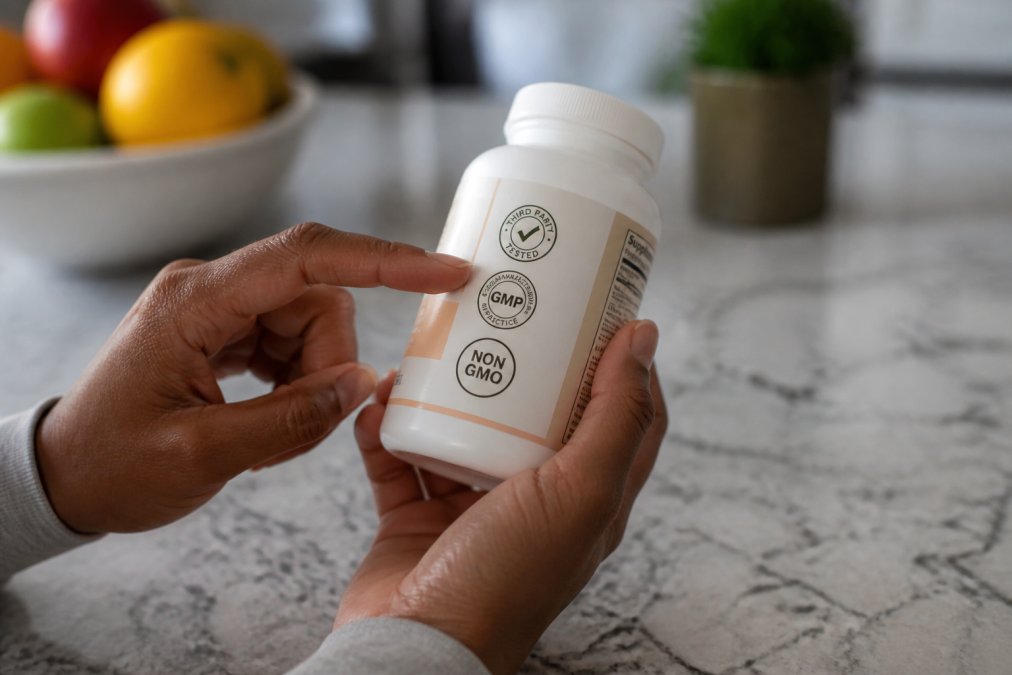
The absence of a seal is not automatically disqualifying. Smaller premium brands often conduct the same rigorous testing but cannot afford the annual licensing fees. In that case, look for a statement about third-party testing on the brand's website or request a batch-specific certificate of analysis.
Step 2: How to Read Supplement Labels for Fillers and Additives
Reading a label is a two-part exercise: examine the Supplement Facts panel and the ingredient list below it.
The number one red flag is a proprietary blend. This legal loophole allows manufacturers to list the total weight of a blend without disclosing individual dosages. If you see "Proprietary Blend 500mg," you have no idea how much of each ingredient you are getting, the cheapest one could make up 90% of the weight.
How to read supplement labels effectively means scanning for these common red flags:
- Magnesium stearate and silicon dioxide in large quantities, which are flow agents used in manufacturing
- Artificial colors, titanium dioxide, or carrageenan as fillers
- Soy, gluten, or dairy if you have sensitivities, which are common hidden allergens
- "Natural flavors" without specification, which can mask synthetic additives
The best labels are short. A high-quality supplement should list the active ingredients, a few capsule materials, and little else.
Step 3: Verify Potency and Bioavailability of Key Ingredients
A label can list an ingredient at the correct dose, but that tells you nothing about whether your body can actually absorb and use it.
Bioavailability is the proportion of an ingested nutrient that reaches systemic circulation, influenced by the ingredient's chemical form and solubility. Magnesium oxide has an absorption rate of roughly 4% compared to glycinate or citrate, which approach 30% or more (ods.od.nih.gov). Folic acid requires liver conversion, whereas methylfolate (5-MTHF) is already active, critical for the estimated 40% of people with MTHFR gene variants that impair that conversion.
Verify three things: the dose matches clinical trials, the form is one your body recognizes, and the product contains necessary cofactors or enhancers.
1. Clinically studied dose
Look up the ingredient on the NIH Office of Dietary Supplements fact sheets (ods.od.nih.gov) or PubMed. Note the exact dose and form used in the study, then compare it to the label. A product listing "ashwagandha extract 300 mg" may sound reasonable, but if clinical evidence used 600 mg of a standardized KSM-66 extract, it is underdosed. The same applies to omega-3s: a softgel claiming "fish oil 1000 mg" might contain only 300 mg of combined EPA and DHA.
2. Bioavailable ingredient forms
Different forms of the same nutrient have vastly different absorption profiles. Common distinctions include:
- Magnesium: oxide is poorly absorbed and often used as a laxative; glycinate, citrate, and threonate are well-absorbed and cross the blood-brain barrier more effectively.
- Vitamin D: D3 (cholecalciferol) is approximately 87% more potent at raising serum 25-hydroxyvitamin D levels than D2 (ergocalciferol) over time.
- Vitamin B12: cyanocobalamin is synthetic and requires conversion; methylcobalamin is the active coenzyme form used directly by the nervous system.
- Curcumin: has extremely low natural bioavailability; look for products with piperine (black pepper extract), phytosomes (Meriva), or nanoparticle formulations that increase absorption up to 20-fold.
- Coenzyme Q10: ubiquinone must be converted to ubiquinol in the body; ubiquinol is the active antioxidant form and is better absorbed, especially in older adults.
- Iron: ferrous sulfate is common but causes GI distress; ferrous bisglycinate is gentler and better absorbed, especially when taken with food.
3. Absorption enhancers and cofactors
Some ingredients need partners to work. Vitamin D3 requires vitamin K2 (as MK-7) to direct calcium into bones rather than soft tissues. Fat-soluble vitamins (A, D, E, K) need dietary fat for absorption, check whether the product includes an oil base or recommends taking with a meal. Zinc and copper compete for absorption, so high-dose zinc supplements should include copper to prevent deficiency over time.
Look for the word "standardized" on the label. A standardized extract guarantees a consistent level of active compounds from batch to batch. For example, a standardized green tea extract should state it contains at least 50% EGCG. Without standardization, potency can vary wildly between batches.
Consider the delivery form. Capsules are more stable than gummies, which degrade faster due to heat and sugar content. Tablets often contain binders that reduce dissolution.
Step 4: Know the FDA Supplement Regulation Facts
The FDA regulates dietary supplements as a category of food, not as drugs. Manufacturers are responsible for ensuring products are safe and labels truthful, but they do not need FDA approval before selling.
This creates a significant gap: a product can legally enter the market with no pre-market safety review, no efficacy testing, and no independent verification of label claims.
What this means for you is that regulatory compliance alone is a low bar. A supplement can be fully FDA-compliant and still contain adulterated ingredients, inaccurate dosages, or harmful levels of contaminants. The FDA's adverse event reporting system for dietary supplements is a tool you can use to check whether a specific product has a history of safety complaints, but you should not interpret FDA compliance as a quality endorsement.
A common misconception is that "FDA-registered facility" or "FDA-approved" means the product has been reviewed. It does not.
Step 5: Spot Red Flags in Marketing and Label Claims
Marketing language reveals a great deal about a brand's confidence. Supplements that rely on hype follow predictable patterns.
The disease-claim test
The most obvious red flag is any claim that a product can "cure," "treat," "prevent," or "diagnose" a disease. Only FDA-approved drugs can make these claims. Language like "supports healthy blood sugar levels already in the normal range" is a legal structure/function claim, but "lowers A1C in diabetics" is an illegal disease claim.
The FTC requires "competent and reliable scientific evidence" for health claims, typically at least one randomized, double-blind, placebo-controlled human trial. If a brand says "clinically proven" but cannot name the study or dose, treat that phrase as meaningless.
The specificity test
Vague language is a hallmark of low-quality marketing. Compare:
- Weak: "Boosts your immune system with premium ingredients"
- Strong: "Provides 1000 mg of vitamin C (as ascorbic acid) per serving, which supports normal immune function per FDA-recognized structure/function claims"
The first tells you nothing; the second gives a dose, form, and verifiable claim. Apply this test to every claim. If a brand says "high potency," ask: compared to what? If it says "doctor recommended," ask: which doctor? If it says "clinically studied," ask: at what dose and with what outcome?
The sourcing transparency test
A brand that cannot tell you where its ingredients come from is hiding something. Legitimate manufacturers name their suppliers or state the country of origin. "Manufactured in the US in a cGMP-certified facility" is a baseline requirement, not a differentiator. The most transparent brands provide a certificate of analysis (CoA) for each batch, showing test results for potency, heavy metals, and microbial contamination. If a brand refuses to provide one, that is a significant red flag.
The urgency and scarcity test
Marketing that manufactures urgency, "limited supply," "prices rising tomorrow", is designed to bypass critical thinking. Legitimate brands do not need artificial scarcity; they can produce more inventory. If a brand is more focused on getting you to buy now than on explaining its testing protocols, walk away.
The testimonial wall test
Testimonials are not evidence. A page of five-star reviews claiming "this cured my arthritis" is a liability, it suggests the brand displays disease claims that violate FDA rules. Look instead for batch-specific test results, third-party certifications, and links to published research. A brand that invites scrutiny is confident; one that buries you in anecdotes is not.
The sustainability angle competitors miss
Beyond obvious red flags, there is a quality signal most guides ignore: supply chain transparency. A brand that tells you exactly where ingredients are grown and processed demonstrates operational control that correlates with quality control. A fish oil brand sourcing from MSC-certified fisheries and testing for oxidation and environmental toxins is investing in quality at every stage. Ethical sourcing is a proxy for whether the manufacturer actually knows what is in its product.
A practical verification workflow
Run any supplement claim through this three-step filter:
- Search the exact claim in quotes on Google. If the only results are the brand's own website and affiliate reviews, that is a warning sign.
- Check the FDA's adverse event reporting system (CAERS). A history of serious adverse events is disqualifying.
- Search the FTC's consumer complaint database and DOJ press releases. A pattern of enforcement actions is a clear red flag.
By applying these tests, disease claims, specificity, sourcing transparency, urgency tactics, and testimonial quality, you can separate marketing noise from genuine quality signals.
Your Supplement Quality Checklist
You now have the framework. Here is the condensed checklist you can apply to any supplement, including the ones already sitting in your cabinet:
| Check | What to Look For | Red Flag |
|---|---|---|
| Third-party seal | NSF, USP, or ConsumerLab | Unknown certifier or no testing info |
| Ingredient list | Short, recognizable ingredients | Proprietary blends, artificial colors |
| Dosage forms | Clinically studied doses, bioavailable forms | Undisclosed amounts, cheap forms |
| Regulatory status | FDA-compliant as a baseline, not a selling point | "FDA-approved" claims |
| Marketing language | Specific, evidence-based claims | Disease claims, urgency tactics |
One final consideration most guides overlook: storage and shelf life. A high-quality supplement degrades quickly if exposed to heat, light, or moisture. Check the expiration date and look for protective packaging, such as opaque bottles or desiccant packs.
The supplement aisle is full of products that look identical on the surface. The difference between one that works and one that wastes your money is hidden in the details we have covered. For a practical example, consider the J. Paulo Complete Multivitamin, formulated with a full-spectrum blend and manufactured in the US with rigorous testing standards.

Choosing a supplement is an act of trust. The brands that earn that trust do not hide behind vague marketing; they invite you to examine their labels, testing, and sourcing. At J. Paulo, we build every product to survive that scrutiny, with US manufacturing, rigorous testing, and no cheap fillers. Get started with J. Paulo and experience what a supplement should actually do.
Frequently Asked Questions
Do third-party certifications guarantee supplement safety?
No, a third-party seal does not guarantee safety or effectiveness. It verifies that what is on the label matches what is in the bottle, covering purity and potency for tested contaminants. Reputable seals like NSF or USP also audit manufacturing facilities. For a more complete picture of supplement quality, combine a certification seal with a review of the full ingredient list and the brand's manufacturing standards.
What are the red flags when buying supplements?
Major red flags include proprietary blends that hide individual ingredient amounts, exaggerated claims like 'cures all diseases,' and the absence of any third-party supplement testing seal. Be wary of products with long lists of fillers, artificial colors, or unrecognizable additives. If a label lacks a clear manufacturer address or batch number, that signals poor quality control. Finally, prices far below market average often indicate cheaper, lower-quality ingredients.
How does the FDA regulate dietary supplements?
The FDA regulates dietary supplements under the Dietary Supplement Health and Education Act (DSHEA) of 1994. Unlike drugs, supplements do not need FDA approval before they are sold. Manufacturers are responsible for ensuring their products are safe and that label claims are truthful. The FDA can only take action after a product reaches the market and is found to be unsafe or adulterated, which makes third-party testing an important extra step for verifying quality.