

Are Wellness Supplements Actually Safe?
Table of Contents
- What Supplement Safety Actually Means
- FDA Dietary Supplement Regulation: What the Law Does (and Doesn't) Do
- Supplement Drug Interactions: The Risk Most People Ignore
- Who Actually Needs Dietary Supplements
- Third-Party Supplement Testing: How to Verify What's in the Bottle
- Bioavailability: Synthetic vs. Food-Derived Nutrients
- Supplement Efficacy: Which Ones Have Real Evidence Behind Them
- Conclusion
Last Updated: August 12, 2026
What Supplement Safety Actually Means
Are wellness supplements actually safe? The honest answer is: it depends entirely on the product, the person taking it, and how informed that person is before they swallow anything. At J. Paulo, we believe that question deserves a direct, no-nonsense answer rather than a reassuring non-answer.
Supplement safety is the degree to which a dietary supplement, at its intended dose, produces its intended benefit without causing harm to the user. The reality is considerably more complicated than it sounds.
The supplement industry operates under fundamentally different rules than pharmaceutical drugs. Manufacturers are not required to prove a product is safe or effective before it reaches store shelves. Consumers often assume that "natural" or "wellness-focused" labeling signals rigorous oversight. It does not. Understanding what safety actually means in this context is the first step toward making smarter choices.
| Topic | Key Question | What to Do |
|---|---|---|
| FDA Regulation | Is this product pre-approved? | Understand DSHEA limitations |
| Drug Interactions | Does this affect my medications? | Review with your prescriber |
| Third-Party Testing | Has this been independently verified? | Look for USP, NSF, or Informed Sport logos |
| Bioavailability | Will my body absorb this form? | Compare synthetic vs. food-derived sources |
| Efficacy Evidence | Does the science support this? | Check clinical trial data |
| Storage & Expiration | Is my current bottle still potent? | Follow label storage directions |
FDA Dietary Supplement Regulation: What the Law Does (and Doesn't) Do
FDA dietary supplement regulation is governed by the Dietary Supplement Health and Education Act of 1994, commonly known as DSHEA. Under DSHEA, dietary supplements are classified as a subcategory of food, not drugs. That classification has enormous consequences for consumers.
Manufacturers do not need FDA approval before selling a supplement. They are responsible for ensuring product safety themselves. The FDA's role is largely reactive; it can take action after a product is already on the market if it poses a risk. As documented in FDA's overview of dietary supplement regulation, the agency can remove a dangerous product, but it cannot block one from reaching shelves in the first place.
The law requires manufacturers to follow Current Good Manufacturing Practices, register their facilities, and report serious adverse events. Label claims are also regulated: a supplement cannot claim to treat, cure, or prevent a disease. Companies can make structure-function claims, such as "supports immune health," but these must be accompanied by a disclaimer stating the FDA has not evaluated the claim. Quality control, standardization, and purity standards remain the manufacturer's responsibility.
The 'Natural' Myth and Why It Matters
The word "natural" on a supplement label carries no legal definition under FDA rules. It is a marketing term, nothing more.
Many consumers assume natural origin equals safety. Arsenic is natural. So is hemlock. The relevant question is not where an ingredient comes from but whether it has been tested for purity, potency, and heavy metal contamination at a therapeutic dose. Some botanical ingredients interact with medications; others accumulate in the body at high doses and cause toxicity.
Supplement Drug Interactions: The Risk Most People Ignore
Supplement drug interactions are among the most underreported health risks in the wellness space. Most people who take prescription medications never mention their supplements to their prescriber, and most prescribers never ask.
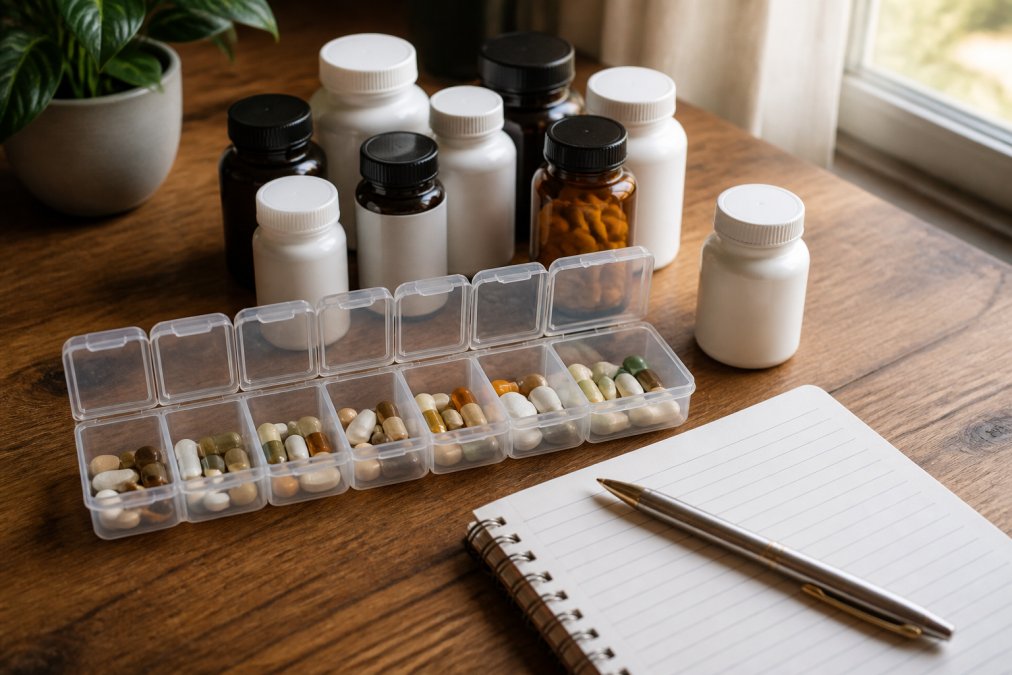
Some supplements affect the enzymes that metabolize drugs in the liver, altering how quickly a medication is processed. St. John's Wort, for example, reduces the effectiveness of blood thinners, oral contraceptives, and certain antidepressants by accelerating drug metabolism. Others affect nutrient absorption, meaning a supplement taken at the wrong time can block the uptake of a medication entirely.
For anyone on blood pressure medications, cholesterol-lowering drugs, or anticoagulants, this is not a theoretical risk. According to the National Institutes of Health Office of Dietary Supplements, vitamin K affects warfarin, high-dose calcium can interfere with certain antibiotics, and magnesium can reduce the absorption of some thyroid medications.
Bring a list of every supplement you take to your next appointment and ask specifically about contraindications. A two-minute conversation can prevent a serious adverse event.
Who Actually Needs Dietary Supplements
Most healthy adults eating a varied, balanced diet do not need a broad supplement regimen. Genuine need for dietary supplements typically falls into specific, identifiable categories: nutritional deficiency driven by diet restriction, malabsorption, or increased physiological demand.
Common groups with genuine supplementation needs include:
- Adults over 50, who often absorb vitamin B12 and vitamin D less efficiently
- Pregnant individuals, for whom folate and iron are clinically critical
- People following vegan or vegetarian diets, who may be low in B12, zinc, and omega-3s
- Individuals with diagnosed malabsorption conditions such as Crohn's disease or celiac disease
- Those with limited sun exposure, where vitamin D supplementation is widely supported
Supplements are designed to supplement a diet, not replace it. The evidence base for whole-food nutrition consistently outperforms isolated nutrient supplementation for general health maintenance.
Pediatric and Geriatric Considerations
Pediatric and geriatric populations require specific attention because standard adult dosage guidelines do not apply to either group.
Children's bodies process nutrients differently, and dosing is weight- and age-dependent. Several fat-soluble vitamins, particularly vitamins A and D, carry real toxicity risk at doses that would be unremarkable for an adult. Parents should consult a pediatrician before adding any supplement to a child's routine.
Older adults face different challenges. Absorption of several key micronutrients declines with age, and the risk of supplement-drug interactions increases as polypharmacy becomes more common. The pharmacokinetics of how the body handles nutrients shift meaningfully after age 65, and dosage guidelines designed for younger adults may not apply.
Third-Party Supplement Testing: How to Verify What's in the Bottle
Third-party supplement testing is the single most reliable method consumers have for verifying that a supplement contains what its label claims, at the stated potency, without contaminants.

Because FDA regulation does not require pre-market approval, the burden of quality verification falls on the consumer. Third-party testing organizations independently analyze products for label accuracy, purity standards, and the absence of heavy metal contamination, banned substances, and harmful adulterants. According to ConsumerLab's independent supplement testing findings, a meaningful proportion of tested supplements fail to meet their label claims.
Certification Logos Worth Trusting
These certification logos represent genuinely rigorous third-party testing:
- USP Verified: The United States Pharmacopeia sets pharmaceutical-grade standards for potency, purity, and manufacturing quality. USP verification is one of the most credible marks in the industry.
- NSF International: NSF Certified for Sport signals rigorous contamination testing. NSF also offers a general dietary supplement certification.
- Informed Sport / Informed Choice: Batch-tested for banned substances; particularly relevant for performance supplements.
- ConsumerLab Approved: Based on independent laboratory testing of actual purchased products.
Look for at least one of these logos on the product label or the brand's website.
Storage, Expiration, and Purity Standards
Storage conditions directly affect supplement efficacy and safety. Heat, humidity, and light degrade active ingredients. Expiration dates represent the manufacturer's guarantee of potency through that date under recommended storage conditions.
Bioavailability: Synthetic vs. Food-Derived Nutrients
Bioavailability describes how much of an ingested nutrient actually reaches systemic circulation and becomes available for the body to use. It is one of the most practically important factors in supplement efficacy.
In some cases, synthetic vitamins are chemically identical to their food-derived counterparts and are absorbed just as well. Synthetic vitamin C has comparable bioavailability to vitamin C from whole foods. In other cases, the form matters considerably. Magnesium glycinate and magnesium oxide have substantially different absorption rates, as do folate and folic acid.
The ingredient form listed on a supplement label is worth paying attention to, not just the ingredient name. A supplement with a higher milligram count in a poorly absorbed form may deliver less actual nutrient than a lower-dose product using a more bioavailable form.
Nutrient absorption is also affected by what you eat alongside a supplement. Fat-soluble vitamins require dietary fat for absorption. Iron absorption is enhanced by vitamin C and inhibited by calcium. These interactions are a reason to take supplements thoughtfully.
Supplement Efficacy: Which Ones Have Real Evidence Behind Them
The evidence base for dietary supplements varies enormously across products. Some have been studied extensively in clinical trials; others are sold on preliminary research or marketing.
The supplements with the strongest evidence for specific applications include:
- Vitamin D: Widely supported for bone health maintenance, immune function, and addressing deficiency in populations with limited sun exposure
- Omega-3 fatty acids: Strong clinical trial evidence for cardiovascular health in individuals with elevated triglycerides
- Folate: Critical for neural tube development during pregnancy
- Magnesium: Supported for sleep quality, muscle function, and addressing deficiency
- Vitamin B12: Essential for neurological function; supplementation is well-supported for older adults and those following plant-based diets
- NMN: Emerging research supports its role in supporting NAD+ production, a coenzyme involved in cellular energy metabolism
J. Paulo's approach is to formulate around ingredients with a real rationale behind them. The J Paulo Complete Multivitamin covers foundational micronutrient gaps with no cheap fillers. The JPaulo NMN delivers 500 mg of beta-Nicotinamide Mononucleotide at 99.9% purity, targeting cellular energy support. And the JPaulo Sleep Support uses magnesium citrate and vitamin B6, both of which have genuine mechanistic support for sleep and muscle relaxation.


The quality of the raw ingredient matters as much as whether the ingredient itself has evidence. A poorly sourced, low-purity version of an evidence-backed compound will not deliver the results the research predicts.
For a comprehensive look at what the clinical evidence actually shows for common supplements, the NIH Office of Dietary Supplements fact sheets provide well-sourced, regularly updated summaries by ingredient.
Frequently Asked Questions
How does the FDA regulate dietary supplements compared to prescription drugs?
Dietary supplements fall under the Dietary Supplement Health and Education Act (DSHEA) of 1994, which means manufacturers do not need FDA approval before selling a product. The FDA can act only after a supplement is already on the market and proven harmful. Prescription drugs, by contrast, must pass clinical trials and receive FDA approval before sale. This gap in regulatory oversight is why third-party testing and quality control practices matter so much for supplement safety.
Can supplements interact negatively with prescription medications?
Yes, and the risk is real. St. John's Wort can reduce the effectiveness of blood thinners, antidepressants, and birth control. High-dose vitamin K affects warfarin dosing. Magnesium and calcium can interfere with certain antibiotic absorption. If you take blood pressure or cholesterol medications, always tell your doctor which supplements you use. Supplement drug interactions are one of the most underreported health risks in the over-the-counter wellness market.
What does 'third-party testing' mean for supplement safety?
Third-party testing means an independent laboratory, not the manufacturer, analyzes the supplement for ingredient accuracy, potency, and contaminants like heavy metal contamination or pesticides. Certifications from organizations such as NSF International, USP, or Informed Sport confirm that what's on the label matches what's in the capsule. Without this verification, there is no guarantee the therapeutic dose listed is actually present, or that the product meets basic purity standards.
Are any supplements really worth taking?
Several have strong evidence behind them. Vitamin D is widely recommended for people with limited sun exposure. Folate is critical during pregnancy. Omega-3 fatty acids show consistent results in clinical trials for cardiovascular markers. A complete multivitamin can address nutritional deficiency in people with restricted diets. The key is matching the supplement to an actual need, not taking something because it sounds beneficial. Evidence-based choices tied to your specific health situation produce the most reliable outcomes.
Navigating the supplement market is genuinely difficult. The regulatory gap is real, the quality variation is significant, and the marketing noise makes it harder, not easier, to find products that actually deliver. J. Paulo addresses this directly through US manufacturing, rigorous testing, and formulations built around ingredients that have a legitimate rationale behind them. Explore the J. Paulo product range and find the supplements that fit your specific health goals.
This article was written using GrandRanker